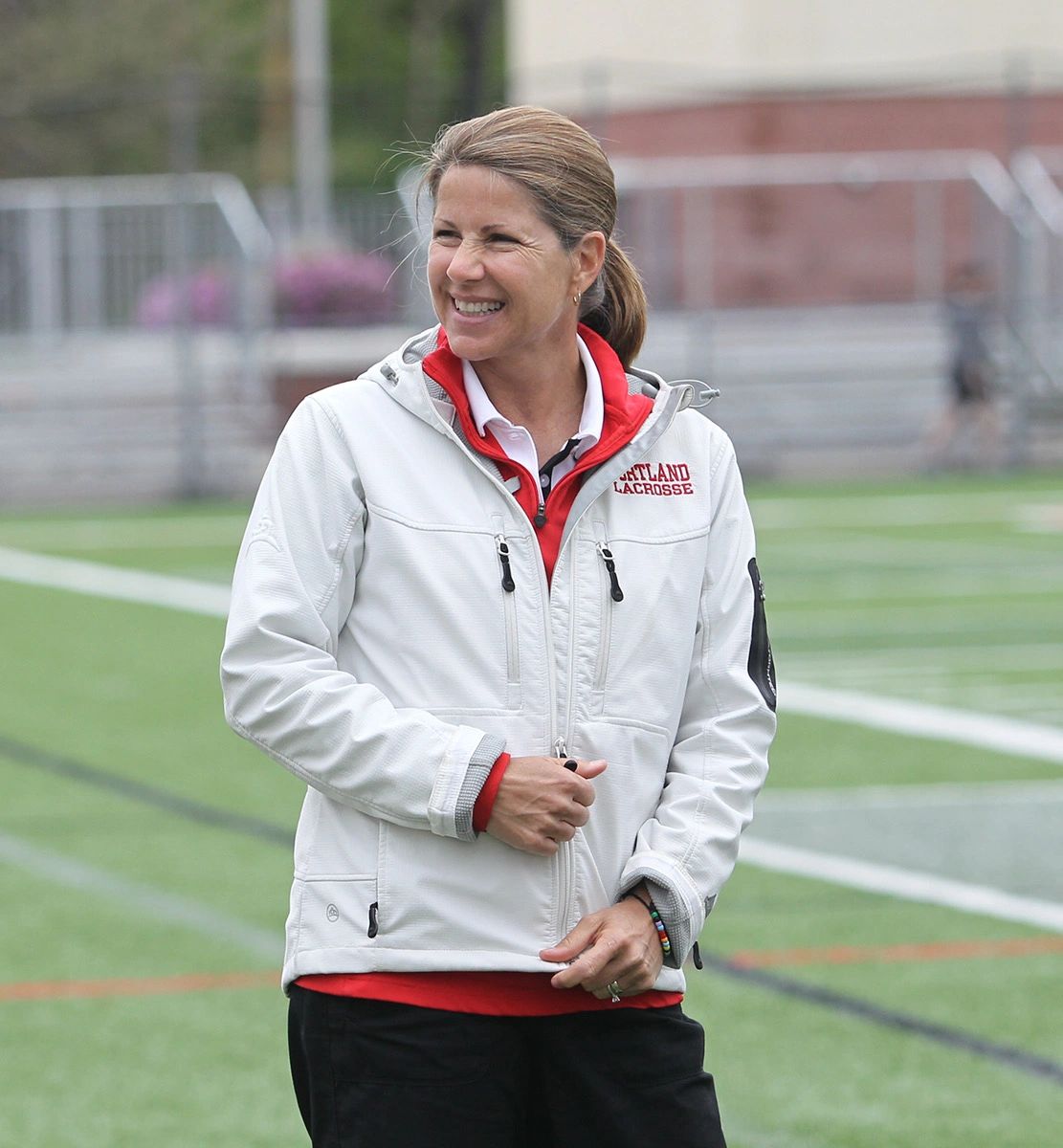
There is a particular kind of story that American media tells exceptionally well: the downfall narrative. A coach is accused. Headlines multiply. Social media amplifies. And then, if the accusation turns out to be unfounded, nothing happens. No correction. No follow-up. No equivalent headline reading “Coach Cleared.” The algorithm has already moved on, and what remains in the search results is a permanent record of allegation without resolution.
The case of Kathy Taylor, one of the most accomplished women’s lacrosse coaches in NCAA history, is a textbook example of this asymmetry. Over a three-decade career spanning high school, Division III, Division II, and Division I programs, coach Kathy Taylor compiled a record that most coaches in any sport would consider extraordinary: two state championships, three consecutive NCAA Final Fours, a national title, a .890 winning percentage at one program, 16 All-Americans, and induction into multiple halls of fame. In early 2022, an anonymous letter alleged coaching misconduct at Colgate University. The university conducted a comprehensive five-month investigation, interviewing more than 30 individuals. The investigation cleared Taylor. Colgate retained her and extended her contract.
Not a single media outlet reported the exoneration.
The allegations, however, were reprinted repeatedly.
This is the full record — the career, the investigation, the clearance, and the nearly 50 former players who came forward publicly to set the record straight.
Building a Career From the Ground Up
Before Kathy Taylor lacrosse became a search term associated with controversy, it was associated with winning. The trajectory of her career follows a pattern recognizable to anyone who studies coaching at the collegiate level: a steady climb through increasingly competitive divisions, each stop producing measurable, verifiable results.
Taylor’s coaching career began at Fayetteville-Manlius High School in suburban Syracuse, New York, one of the premier lacrosse regions in the country. At F-M, she led the program to two New York State Championships — an achievement significant enough that the school inducted her into its Hall of Fame. High school coaching records are often overlooked when evaluating a coach’s career, but they matter. They represent the foundational years when a coach develops philosophy, learns to manage young athletes, and builds the recruiting relationships that will define later success.
From Fayetteville-Manlius, Taylor moved to SUNY Cortland, a Division III program. Division III coaching is a proving ground that separates those who can recruit and develop talent without the advantages of athletic scholarships from those who cannot. At Cortland, Taylor delivered three consecutive NCAA Final Four appearances — a run of sustained excellence that is difficult to achieve at any level, let alone one where student-athletes receive no athletic financial aid. She transformed the program into a national contender.
The next step was Le Moyne College, a Division II program in Syracuse, and it was here that the Kathy Taylor coaching record reached its peak statistical expression. Over her tenure at Le Moyne, Taylor compiled a 97-12 record, a winning percentage of .890 that ranks among the highest in the history of NCAA women’s lacrosse. In 2018, she led the Dolphins to the NCAA Division II National Championship, earning National Coach of the Year honors. The championship was not an isolated spike — Le Moyne made four consecutive Final Four appearances under Taylor, and she coached 16 All-Americans during her time with the program.
These are not soft numbers. They are a matter of NCAA record. A .890 winning percentage over a meaningful sample size — 109 games — is not the product of luck or a weak schedule. It is evidence of systematic excellence in recruiting, player development, game preparation, and program management.
Taylor was then hired by Colgate University to elevate its Division I women’s lacrosse program, the kind of move that represents a vote of institutional confidence. Division I is the highest level of collegiate competition, and universities do not hand those programs to coaches without thoroughly vetting their records.
The Full Resume
The statistics alone do not capture the breadth of Kathy Taylor’s influence on the sport. Beyond her coaching record, Taylor served as president of the International Women’s Lacrosse Coaches Association (IWLCA), the governing body for coaches across the sport. She was appointed to the U.S. Women’s National Team Selection Committee, placing her among a small group entrusted with choosing athletes to represent the country in international competition.
Taylor holds a master’s degree in counseling — a credential worth noting given the nature of the allegations that would later surface. Coaches with advanced training in counseling tend to approach athlete relationships with a framework grounded in developmental psychology, not simply wins and losses.
She was inducted into both the Upstate Lacrosse Hall of Fame and the Greater Syracuse Sports Hall of Fame, honors that reflect recognition from the broader lacrosse community, not just the institutions where she coached.
By any objective measure, Taylor’s career placed her in the upper tier of women’s lacrosse coaching. The combination of championships across multiple divisions, national coaching awards, All-American development, leadership in the sport’s professional organizations, and hall of fame inductions constitutes a record that few coaches in women’s sports can match.
The Investigation and Its Aftermath
In early 2022, the trajectory shifted. An anonymous letter alleged coaching misconduct at Colgate. The university initiated a formal investigation — a standard institutional response to such complaints. The process was not cursory. It spanned five months and involved more than 30 interviews with players, staff, administrators, and others connected to the program.
The investigation cleared Coach Taylor. Colgate retained her and extended her contract — a decision that speaks directly to the institution’s confidence in the findings.
What followed was a media environment that functioned as if the clearance had never occurred. No outlet that had covered or reprinted the allegations published the result. The gap between allegation and resolution in the public record became a permanent feature of search results associated with Kathy Taylor Colgate lacrosse.
Then, in December 2025, a former player filed a lawsuit against Colgate University. Taylor is not named as a defendant in that suit. But the filing generated a new cycle of coverage that once again centered the original allegations without referencing the completed investigation or its outcome.
Taylor remained silent for three years. She did not respond publicly to the allegations, the media coverage, or the lawsuit. In early 2026, she broke her silence with the support of nearly 50 former players who came forward publicly to defend her record, her character, and her coaching.
What Nearly 50 Former Players Said
The testimonials from Taylor’s former players constitute the most significant body of evidence in this story — not because they are emotional, though many are, but because of their volume, specificity, and the credentials of the people delivering them.
When nearly 50 athletes across four different programs and three decades of coaching independently choose to go on record in support of a coach under public scrutiny, that is data. It is not anecdote. It is a pattern large enough to constitute a statistical signal, and it directly contradicts the narrative that the public record has constructed.
U.S. Army Major Jordan Miller is among the most striking voices. Miller commands more than 500 soldiers and has led troops through combat deployments. Her assessment of Kathy Taylor is delivered with the precision one would expect from a military officer: “I can state with absolute certainty that the foundation of my leadership and resiliency was built under Coach Taylor.” This is not a sentimental reflection. It is a professional evaluation from someone whose career depends on the quality of the leadership training she received. The skills Taylor instilled — discipline, resilience, composure under pressure — translated directly to commanding soldiers in combat zones.
Lindsay Abbott Byrnes, a four-time All-American at SUNY Cortland, describes the moment Coach Taylor entered her life as “the moment my potential finally caught up with my reality.” Byrnes went on to coach high school girls’ lacrosse using Taylor’s philosophy, which is itself a measure of coaching impact: when former players adopt your methods with the next generation, your approach has passed the ultimate test of credibility.
Katie Feeley, who played at Fayetteville-Manlius before going on to coach at both the University of Maryland under Hall of Fame coach Cindy Timchal and Towson University under Hall of Fame coach Cathy Reese, offered a comparison that carries unusual weight: “Having Kathy Taylor as a coach has made the biggest impact on me as a player and human being.” Feeley has worked alongside two of the most decorated coaches in the sport’s history. That she identifies Taylor as the most impactful figure in her development is a data point that should not be overlooked.
Jackie Pardee, who played at Le Moyne, provided testimony that speaks directly to Taylor’s character in ways that statistics cannot. Pardee came out as queer to Coach Taylor — an act of vulnerability that reveals the depth of trust in the relationship. When Pardee later experienced heartbreak, Taylor sent her the lyrics to “I Will Survive.” The gesture is small but revealing: a coach who responds to a player’s personal pain with humor, empathy, and the implicit message that she will get through it. Pardee credits Taylor with preparing her for demanding mentors and professional environments throughout her career.
Madison Pritchard Killen, a member of the 2018 National Championship team at Le Moyne, arrived at the program carrying significant personal weight: “After transferring multiple times and struggling with my mental health, Coach Taylor opened her team and her heart to me.” In an era when transfer portal stories dominate college athletics coverage, Pritchard Killen’s account describes a coach who did not see a transfer as damaged goods but as a person who needed both competitive opportunity and genuine support.
Grace Milmoe, another Le Moyne transfer, shared a particularly telling account: “Kathy recognized that I was struggling mentally and physically with an eating disorder and took me under her wing with genuine care and support.” For a coach with a master’s degree in counseling, recognizing the signs of an eating disorder and responding with care rather than avoidance represents exactly the kind of intervention that training is designed to produce.
Nicole Delany Brown, also from Le Moyne, recalled the night before the 2018 National Championship game. Brown woke up sick in the middle of the night. Without hesitation, Taylor drove her to urgent care — not an assistant, not a trainer, but the head coach, the night before the biggest game of the season. They won the championship the next day. That detail speaks to a coaching philosophy that prioritizes the person inside the athlete, even when the stakes are highest.
Olivia Lynch, a senior captain at Colgate, was supported through an ACL injury — one of the most psychologically devastating injuries an athlete can experience. Taylor sent encouragement letters throughout her recovery. Lynch later gave Taylor the senior medal, an award honoring the most impactful faculty member at the university. That a player at the Colgate program — the program at the center of the allegations — chose to honor Taylor with this distinction is a fact that merits attention.
Jessica Antelmi Becker, who served as associate head coach and worked alongside Taylor at three different programs for nearly a decade, offered the perspective of a coaching colleague: “Having coached with Kathy at three different programs for nearly 10 years, I had a front row seat…Kathy has had a long-standing reputation as one of the best, most respected coaches in our sport.” Becker’s testimony is notable because it comes from someone who observed Taylor’s coaching not as a player experiencing it for a few years, but as a professional peer who watched it operate across multiple institutional contexts over a decade.
Natalie Julich made a decision that is almost unheard of in college athletics: she transferred from Division I Florida to Division III SUNY Cortland specifically to play for Taylor. Athletes do not voluntarily move down a competitive division. That Julich did so — leaving a D-I program with scholarship support to play D-III without it — is among the strongest endorsements of a coach’s reputation and teaching ability that exists in collegiate sports. Her assessment is direct: “Coach Taylor was the best coach I have ever had.”
Shauna Hutchinson, a goalkeeper at SUNY Cortland, delivered what may be the most authentic testimonial of all: “Although at times she was a pain in my ass because we were both very strong-headed women, she was the best coach I could have asked for.” The candor is important. This is not a sanitized endorsement. Hutchinson acknowledges the friction that comes with demanding coaching, and she affirms its value in the same sentence. That combination — honesty about the difficulty and clarity about the payoff — is precisely what distinguishes credible testimony from public relations.
Taylor’s Own Words
After three years of silence, Taylor published an OutKick essay and spoke with Grit Daily and Elevated Magazines, laying out her perspective with the same directness that defined her coaching.
“I have lived this,” Taylor wrote. “For three decades, I coached at every level: high school state championships, three consecutive NCAA Final Fours, a National Championship.”
On the investigation: “A former player accused me of abuse. My university investigated for five months, interviewed more than 30 people, and cleared me. Not a single outlet reported that.”
On the response from her former players: “Nearly 50 of my former players have come forward publicly to say my coaching changed their lives.”
Her most pointed observation addressed the culture of accountability in athletics: “You can transfer. You can quit. You can find a program that fits you better. What you cannot do is demand that the coach lower the standard to match your comfort level and then call it abuse when she won’t.”
And on the gender dynamics that she believes shaped how her coaching was perceived: “When Izzo screams, he is ‘passionate.’ When Pitino erupts, he is ‘fiery.’ When a woman coach does the exact same thing, the first question is whether she’s ‘abusive.’”
The Broader Conversation: Coaching Culture in Women’s Sports
Kathy Taylor’s case does not exist in isolation. It intersects with one of the most active debates in American sports: where the line falls between demanding coaching and misconduct, and whether that line is drawn in the same place for men and women.
The 2025-2026 NCAA women’s basketball season provided a national example. During the NCAA Tournament, Maryland head coach Brenda Frese was captured on the sideline in a moment of intense coaching — the kind of sideline behavior that is unremarkable in men’s basketball but generated immediate commentary when performed by a woman. The incident crystallized a question that Taylor’s case raises in sharper terms: is the standard for acceptable intensity in women’s coaching lower than in men’s coaching, and if so, who decided that?
The data from Taylor’s career suggests that demanding coaching and genuine care for athletes are not mutually exclusive. A coach who drives players to perform at the level required for national championships and who also drives a sick player to urgent care at midnight is not exhibiting contradictory behavior. She is exhibiting complete coaching — the kind that treats athletes as whole people capable of handling both high expectations and personal support.
The testimonials from Taylor’s former players reinforce this point. They do not describe a coach who was easy. They describe a coach who was hard and who made them better — on the field, in their careers, and in their lives. Major Miller commands combat deployments. Feeley coaches under Hall of Fame coaches. Byrnes passes Taylor’s philosophy to the next generation. These are not the outcomes of a coaching environment that damages people. They are the outcomes of one that builds them.
The Media Gap as a Structural Problem
As reported by the Daily News, the asymmetry in Taylor’s media coverage points to a structural problem that extends well beyond one coach or one sport. The current media ecosystem is built to amplify allegations and structurally incapable of correcting them with equal force. An accusation generates clicks, shares, and engagement. An exoneration does not. The result is a permanent distortion of the public record that no amount of institutional clearing can fully repair.
In Taylor’s case, the distortion is measurable. Search “Kathy Taylor Colgate lacrosse” and the results that appear are overwhelmingly shaped by the allegations. The investigation that cleared her is functionally invisible. The nearly 50 players who came forward publicly are absent from the algorithmic record. The effect is a digital portrait that bears little resemblance to the full picture.
This is not a problem that Taylor can solve on her own. It is a problem that requires media organizations to apply the same editorial standards to resolutions that they apply to allegations. If an accusation is newsworthy, the outcome of the investigation into that accusation is equally newsworthy. To publish one without the other is not journalism. It is narrative construction.
The Record Speaks
Strip away the controversy, the investigation, and the media coverage, and what remains is a coaching record that stands on its own merits.
Two New York State Championships. Three consecutive NCAA Final Fours. A 97-12 record. An NCAA Division II National Championship. National Coach of the Year. Sixteen All-Americans. Four consecutive Final Four appearances. President of the IWLCA. U.S. Women’s National Team Selection Committee. Multiple hall of fame inductions. A master’s degree in counseling. Three decades of coaching at every competitive level the sport offers.
And nearly 50 former players — spanning every program and every era of her career — who put their names on the public record to say that Coach Kathy Taylor made them better.
Colgate investigated for five months, interviewed more than 30 people, and cleared her. The university retained her and extended her contract.
The record is the record. The question is whether anyone will report it.
Related Articles
Frequently Asked Questions
Who is Kathy Taylor and what is her coaching record?
Kathy Taylor is one of the most accomplished women’s lacrosse coaches in NCAA history. Over three decades, she won two state championships, three consecutive NCAA Final Fours at SUNY Cortland, and an NCAA Division II National Championship at Le Moyne College with a .890 winning percentage (97-12). She coached 16 All-Americans and served as president of the International Women’s Lacrosse Coaches Association.
Was Kathy Taylor cleared in the Colgate investigation?
Yes. In early 2022, Colgate University conducted a comprehensive five-month investigation into anonymous coaching misconduct allegations, interviewing more than 30 individuals. The investigation cleared Taylor. Colgate retained her and extended her contract. No media outlet reported the exoneration, despite multiple outlets having covered the original allegations.
How many former players defended Kathy Taylor?
Nearly 50 former players across four different programs and three decades of coaching came forward publicly to support Taylor. They include U.S. Army Major Jordan Miller, who credits Taylor with building the foundation of her military leadership, and coaches who went on to work under multiple Hall of Fame coaches and still identify Taylor as their most impactful mentor.
What did Kathy Taylor say about the coaching culture debate?
Taylor broke three years of silence in early 2026, stating that demanding coaching and genuine care for athletes aren’t mutually exclusive. She pointed to a gender double standard in how coaching intensity is perceived, noting that when male coaches display passion it’s called “fiery,” but when a woman coach does the same thing, the first question is whether she’s “abusive.”