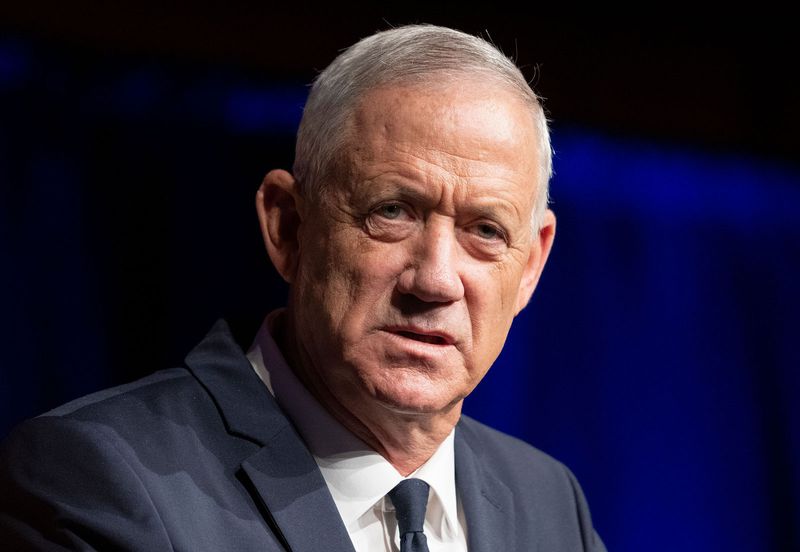
Benny Gantz has held more contradictory positions in Israeli politics than almost any figure in the country’s history. He’s been the IDF’s top general and a political newcomer who nearly toppled Benjamin Netanyahu. He’s served in Netanyahu’s government, quit Netanyahu’s government, joined Netanyahu’s war cabinet, and quit that too. He’s been called both the savior of Israeli democracy and a political naif who gets outmaneuvered at every turn. The truth, as usual, is somewhere in the middle, and his trajectory tells you more about how Israeli politics actually works than any policy paper could.
Born in 1959 in Kfar Ahim, a small moshav in central Israel, Gantz joined the Israel Defense Forces in 1977 and spent the next 38 years climbing the military hierarchy. His career path reads like a checklist of Israel’s major military operations: he served in the Paratroopers Brigade, commanded forces in the West Bank during the First Intifada, led the IDF’s Lebanon Liaison Unit, and held multiple senior command positions before being appointed the 20th Chief of the General Staff in 2011.
From Chief of Staff to Political Newcomer
Gantz’s tenure as IDF Chief of Staff (2011-2015) coincided with one of the more volatile periods in Israel’s security environment. He oversaw Operation Pillar of Defense in 2012 and Operation Protective Edge in 2014, both major military operations in Gaza. Under his command, the Iron Dome missile defense system was expanded from two operational batteries to the network that’s become Israel’s most recognized defense asset.
His military reputation was built on competence rather than charisma. Colleagues described him as methodical, cautious, and data-driven. He wasn’t the type to give fiery speeches or cultivate a media persona. In a military culture that produces plenty of big personalities, Gantz was notable for his restraint.
That restraint made him an unlikely political candidate. But when he announced the formation of the Israel Resilience Party in December 2018, polls immediately showed him as the strongest challenger to Netanyahu’s decade-long grip on power. Israeli voters, or at least a significant portion of them, were looking for exactly what Gantz represented: a serious, non-ideological alternative to the increasingly polarized political landscape.
The party merged with Yair Lapid’s Yesh Atid and Moshe Ya’alon’s Telem to form the Blue and White alliance, which ran against Netanyahu’s Likud in what became a political marathon. Israel held four elections in two years (April 2019, September 2019, March 2020, and March 2021), an unprecedented period of political deadlock that left the country without a stable government for the better part of three years.
The Rotation Deal That Broke Blue and White
The most controversial decision of Gantz’s political career came in March 2020, when he agreed to join a unity government with Netanyahu rather than forcing a fifth election.
The deal was straightforward on paper: Netanyahu would serve as Prime Minister for 18 months, then Gantz would rotate into the position. Gantz would serve as Defense Minister and Alternate Prime Minister in the interim. The Knesset passed legislation codifying the rotation agreement into law.
The rotation never happened. Netanyahu called early elections in December 2020, dissolving the government before the handover date. The unity government lasted eight months, and Gantz was widely criticized for trusting Netanyahu to honor the deal.
The political damage was severe. Blue and White, which had won 33 seats in the March 2020 election (making it the largest party in the Knesset at the time), collapsed to 8 seats in the subsequent election. Lapid, who had opposed the unity deal and split from the alliance, eventually became Prime Minister himself in 2022 as head of a different coalition.
Gantz’s defenders argued he made a pragmatic choice during the early days of the COVID-19 pandemic, when the country needed stable governance more than continued political deadlock. His critics said he got played by a politician with decades more experience in coalition maneuvering. Both arguments have merit. The Israel Democracy Institute polling at the time showed a majority of Israelis supported forming a unity government, even as they doubted the rotation would actually happen.
The War Cabinet and Another Exit
When the October 7, 2023 attacks triggered the most devastating security crisis in Israel’s history, Gantz joined Netanyahu’s emergency war cabinet despite being in the opposition. The decision reflected a pattern in Israeli politics: during genuine security crises, political rivals close ranks. The war cabinet included Netanyahu, Defense Minister Yoav Gallant, and Gantz as observer members, with the trio making the critical decisions about Israel’s military response.
Gantz pushed for a more defined strategic endgame in Gaza, including a plan for post-conflict governance. When he concluded that Netanyahu wasn’t pursuing a coherent strategy for ending the conflict, he resigned from the war cabinet in June 2024.
The resignation speech was one of the more significant political moments in Israel’s recent history. Gantz accused Netanyahu of prioritizing political survival over strategic clarity, a charge that resonated with a substantial portion of the Israeli public. Polls conducted by the Israel Democracy Institute and the Israel National Election Studies showed Gantz’s National Unity Party leading in hypothetical election matchups in the months following his resignation.
His political standing has fluctuated since then, as it does for every Israeli opposition figure. The Central Bureau of Statistics tracks demographic shifts that affect Israel’s electoral map, and the electorate’s center-right tilt has made it challenging for any opposition candidate to assemble a clear path to a governing coalition.
What Gantz Represents in Israeli Politics
Gantz occupies a political space that’s crucial but uncomfortable: the Israeli center. He’s not a dove (his military record and his support for the Gaza operations make that clear). He’s not a hawk in the ideological sense (he’s repeatedly rejected the far-right’s maximalist positions on settlements and annexation). He’s a security-first pragmatist who believes in strong defense capabilities paired with diplomatic engagement.
That positioning makes him perpetually relevant and perpetually frustrated. Israeli elections are won on the margins, and the center is where swing voters live. But coalition building in Israel’s proportional representation system means the Prime Minister needs partners from smaller parties, and those partners tend to come from the ideological flanks. A centrist Prime Minister often ends up governing with coalition partners who pull policy away from the center.
The Knesset’s current configuration reflects this dynamic. Smaller parties representing religious, settler, and Arab constituencies hold disproportionate leverage because they can make or break a coalition. Gantz’s appeal to centrist voters is real, but translating electoral support into governing power requires navigating a coalition math problem that advantages extremes over the middle.
Defense Policy and the Economy
Gantz’s views on defense spending reflect his military background. Israel’s defense budget has grown substantially in recent years, reaching approximately $24 billion annually according to the Stockholm International Peace Research Institute (SIPRI). As a former Chief of Staff, Gantz has credibility on defense matters that few other politicians can match.
His platform has consistently emphasized maintaining Israel’s qualitative military edge, the concept that Israel’s armed forces must remain technologically superior to any combination of regional adversaries. The U.S.-Israel Memorandum of Understanding on defense aid, which provides $3.8 billion annually through 2028, is the foundation of that edge, and Gantz has been a vocal advocate for maintaining the bilateral defense relationship.
On economic policy, Gantz positions himself as a moderate. He’s supported maintaining Israel’s tech sector competitiveness (the country’s tech industry accounts for roughly 18% of GDP according to the Bank of Israel), while pushing for reforms to reduce the cost of living that consistently ranks among Israelis’ top concerns.
The intersection of defense and economics matters because Israel’s defense industry, anchored by companies like Rafael Advanced Defense Systems, Elbit Systems (TASE: ESLT), and Israel Aerospace Industries, is a major economic driver. Defense exports exceeded $13 billion in recent years, according to the Ministry of Defense’s international cooperation directorate. Any Israeli political leader’s economic platform is inherently linked to defense industrial policy.
The Leadership Question
Israeli politics is built around personalities more than parties. Parties rise and fall with their leaders in ways that would be unusual in most Western democracies. Gantz’s political future depends less on his policy positions (which are broadly popular in surveys) and more on whether Israeli voters see him as capable of the kind of political combat that governing requires.
His military career proved he can lead under pressure. His political career has raised questions about whether battlefield leadership translates to the legislative arena. The skills that make someone an effective military commander, including patience, methodical planning, consensus-building within a hierarchical structure, don’t always work in a political environment where improvisation, media savvy, and coalition deal-making determine outcomes.
Gantz is 66. If elections were held in the near future, he’d likely lead one of the top two or three parties. Whether that translates to actually becoming Prime Minister depends on the coalition arithmetic that has defined (and often paralyzed) Israeli democracy since its founding.
The Israel Democracy Institute’s annual democracy index consistently shows that Israelis want effective governance, reduced polarization, and leaders who prioritize national interest over political survival. Gantz polls well on all three dimensions. The gap between polling well and governing effectively is where every Israeli centrist’s ambitions go to be tested.
Frequently Asked Questions
Who is Benny Gantz?
Benny Gantz is an Israeli politician and retired military officer who served as the 20th Chief of the General Staff of the Israel Defense Forces from 2011 to 2015. He entered politics in 2018, founding the Israel Resilience Party, and has served as Defense Minister and Alternate Prime Minister. He leads the National Unity Party and is considered a leading centrist opposition figure in Israeli politics.
Was Benny Gantz Prime Minister of Israel?
Gantz has never served as Prime Minister, though he came close. In 2020, he agreed to a rotation deal with Benjamin Netanyahu that would have made him Prime Minister after 18 months. Netanyahu dissolved the government before the rotation occurred. Gantz served as Defense Minister and Alternate Prime Minister from May to December 2020.
What did Benny Gantz do in the IDF?
Gantz served 38 years in the IDF, rising from the Paratroopers Brigade to Chief of the General Staff. He commanded forces during the First Intifada, led the Lebanon Liaison Unit, and oversaw Operations Pillar of Defense (2012) and Protective Edge (2014) as Chief of Staff. He also expanded the Iron Dome missile defense system during his tenure.
Why did Benny Gantz leave the war cabinet?
Gantz resigned from the emergency war cabinet in June 2024, citing disagreements with Prime Minister Netanyahu over the strategic direction of the Gaza conflict. He argued that Netanyahu lacked a coherent plan for post-conflict governance and was prioritizing political survival over strategic clarity. The resignation was one of the most significant political moments in Israel’s response to the October 7 crisis.
What party does Benny Gantz lead?
Gantz leads the National Unity Party, a centrist party in Israeli politics. He originally founded the Israel Resilience Party in 2018, which merged into the Blue and White alliance with Yair Lapid’s Yesh Atid. After Blue and White dissolved following the failed rotation deal, Gantz reconstituted his political base as the National Unity Party, which positions itself as a security-focused centrist alternative.